Systems Design Case Study
Secure Internal Tooling Platform
Designing and operating a zero-trust internal platform that protects sensitive tooling, enforces least-privilege access, and remains fast enough for everyday developer workflows.
The Problem
Internal tools often start as convenience utilities and slowly become business-critical systems. Over time, they are exposed directly to the internet, protected only by weak authentication or shared credentials, creating unnecessary attack surface and operational risk.
Constraints
- • Zero public exposure of internal services
- • Centralized identity and authentication
- • Enforced least-privilege access by default
- • Minimal friction for developers and operators
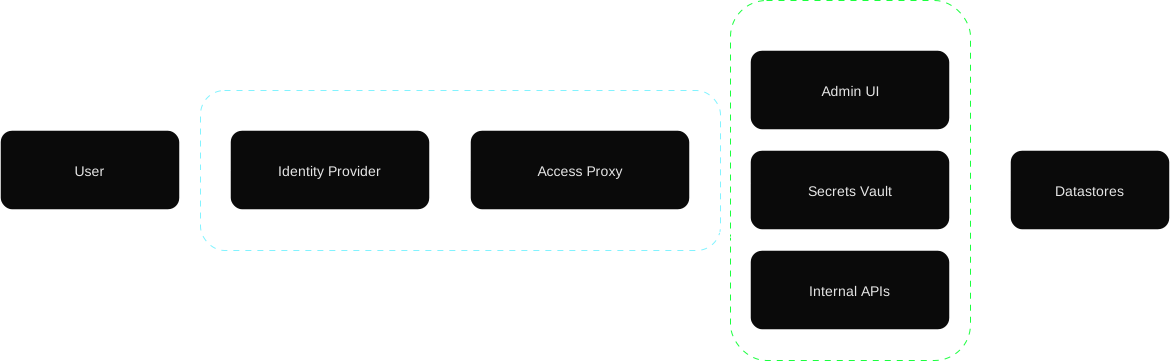
Architecture Overview
The platform is built around a zero-trust access model where internal services are never directly exposed to the public internet. All access flows through an identity-aware proxy that authenticates users and evaluates access policies before a request ever reaches an internal service.
Services run in isolated Docker containers on private networks. Secrets, credentials, and service configuration are injected at runtime via environment variables and encrypted secret stores—never committed to source control or baked into images.
Security Model
- • Identity-first access: Requests are authenticated using centralized identity providers instead of IP allowlists or shared credentials.
- • No direct ingress: Internal services are unreachable without passing through the access layer, eliminating entire classes of scanning and brute-force attacks.
- • Least privilege by default: Access policies are scoped per service and per role, reducing blast radius in the event of credential compromise.
- • Auditability: Access decisions and service requests are logged centrally for review, monitoring, and incident response.
CI/CD & Deployment Workflow
All internal tools are deployed via a container-based CI/CD pipeline designed to be repeatable, auditable, and environment-agnostic.
• Code changes are pushed to GitHub, triggering automated GitHub Actions workflows.
• GitHub Actions builds a production-ready Docker image, runs basic validation checks, and tags the image using commit SHAs or semantic versioning.
• The image is published to Docker Hub as a trusted artifact, keeping runtime environments decoupled from the build process.
• Deployment servers pull approved images from Docker Hub and restart services using Docker Compose or container orchestration tools.
• Secrets and environment-specific configuration are injected at deploy time, allowing the same image to run safely across staging and production.
This workflow ensures deployments are predictable, rollbacks are fast, and no production systems rely on locally built or manually modified containers.
Operational Outcomes
- • Internal tools are fully shielded from public attack surface
- • Access changes propagate instantly via centralized identity
- • New tools can be deployed safely without rethinking security
- • Developers ship faster without managing credentials manually